
DPF regen failed — what now?
A failed parked regen isn't the end — but ignoring it is. Here's the progression from "regen needed" warning to forced derate, and what's fixable roadside.
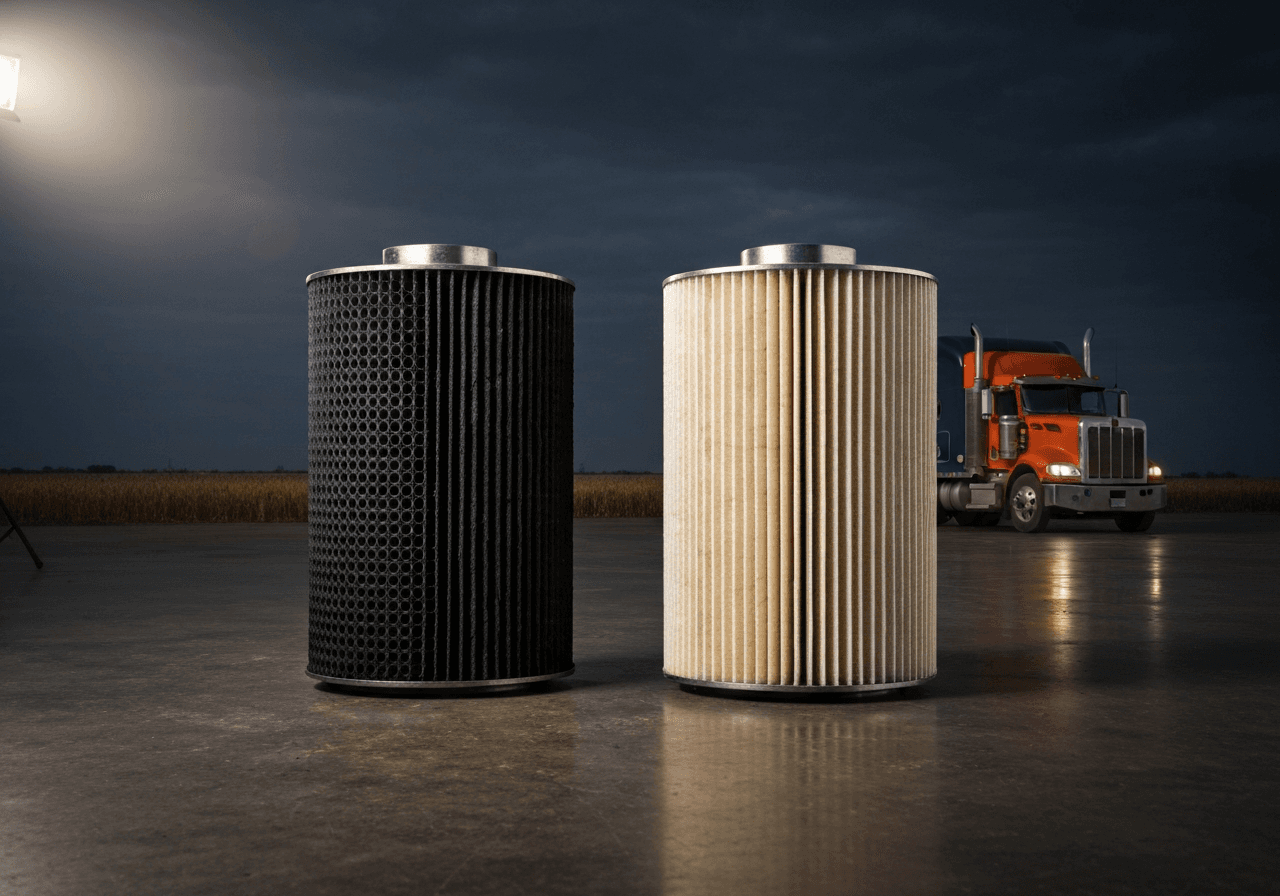
A failed DPF regen means the truck couldn't burn off the accumulated soot in the diesel particulate filter — either because conditions weren't right for active regen (cold weather, short hauls, low EGT) or because something in the regen system itself has failed. You typically get one or two attempts at a parked regen before the truck escalates to forced derate. What you do in that window decides whether you're back on the road in an hour or in the shop for two days.
The DPF regen escalation, in order
- DPF regen needed warning (amber) — soot load past the active-regen threshold, truck is requesting a parked regen at your convenience.
- Parked regen required (amber, persistent) — truck won't initiate active regen on its own anymore. You need to do a parked regen or take it for a hard pull.
- Engine protection / derate begins (25% power) — soot load past safe threshold, truck reducing power to limit further soot generation.
- Forced derate / shutdown sequence — full power reduction. Some engines require a tow at this point; others give one limp-home cycle.
What causes a regen to fail
Active regen requires four things to all work: high exhaust gas temperature (typically 1,000°F+), a working dosing system (for engines that use HC dosing), a functional EGR system, and a DPF that isn't physically damaged or excessively loaded. Failure of any one prevents the regen from completing.
- EGT too low — caused by leaking exhaust, failed HC doser, or just short-haul duty cycle that never builds heat
- Excessive soot load (above ~100g) — DPF is past the point of regen recovery and needs cleaning or replacement
- Failed differential pressure sensor — ECM doesn't know how loaded the DPF actually is
- Failed EGT sensors (DPF inlet, outlet, or mid-bed) — ECM can't verify regen is happening
- Open or restricted exhaust — pressure drop wrong, regen can't initiate
- Engine oil dilution — fuel in the oil from previous failed regens compounds the problem
What we can fix roadside vs what needs a shop
The deciding factor is the soot load reading. If the DPF is at 80g or below and a parked regen is just failing for one of the sensor or actuator reasons above, we can usually fix it on-site and run the regen. Above ~100g the DPF physically can't recover by regen anymore — it needs to come off the truck for cleaning, which means a shop or a coordinated removal.
| Soot load reading | What's possible roadside | What needs a shop |
|---|---|---|
| < 80g | Diagnose root cause, fix sensor/doser/HC issue, run parked regen on-site | — |
| 80–100g | May be able to force regen with manufacturer scan tool if root cause is also fixable | If forced regen also fails, DPF removal |
| > 100g | Confirm reading is accurate, possibly attempt regen with extended dwell | DPF removal and ceramic cleaning, often catalyst inspection too |
| > 140g | — | Often a new DPF, plus inspection of upstream cause |
Why a parked regen sometimes fails even with everything healthy
A parked regen can't initiate if the truck has any active fault that prevents it: low coolant, low fuel, engine over-temp, exhaust system fault, EGR fault. The first thing we check on a failed parked regen is the inhibit code list — the ECM will tell you exactly why it refused to start. The fix is usually clearing whatever inhibit is preventing it (often an unrelated minor fault that's been sitting active for weeks).
Cost ranges for DPF work
| Service | Typical 2026 cost |
|---|---|
| Roadside forced regen (no parts) | $280 – $450 |
| Differential pressure sensor replacement (roadside) | $320 – $480 |
| EGT sensor replacement (roadside) | $280 – $420 per sensor |
| DPF removal + ceramic cleaning (shop) | $600 – $1,200 |
| DPF replacement (new OE) | $2,800 – $4,500 |
| DPF replacement (reman) | $1,400 – $2,400 |
How to avoid the next failed regen
- Don't ignore the first amber DPF light — schedule a parked regen at your next planned stop instead of waiting for the persistent warning
- If your duty cycle is short-haul with low EGT, schedule preventive parked regens monthly rather than waiting for the truck to request one
- Address upstream causes — EGR cooler leaks, failed turbos, fuel injectors that are over-fueling all push the DPF into early loading
- Use the right oil (CK-4 low-SAPS) — wrong oil dumps ash into the DPF and shortens regen intervals
Frequently asked
Can you force a DPF regen on the side of the road?+
Yes, with a manufacturer-level scan tool for your engine family. The truck has to be safely parked for 40-60 minutes with the engine at fast idle. We've done these at truck stops, rest areas, and even active shoulder pull-offs.
How long does a parked regen take?+
30 to 60 minutes depending on soot load and engine temperature at start. The system runs EGT up to ~1,050-1,150°F to burn off accumulated soot. Don't shut the engine off mid-regen.
What soot load is too high for regen to recover?+
Above ~100g for most engines the DPF physically can't be recovered by regen alone. It needs to come off the truck for ceramic cleaning. Above 140g you're usually looking at replacement.
Will repeated regen failures damage anything?+
Yes. Each failed regen dumps fuel that ends up in the oil (fuel dilution) and on the DPF face. Compounded over multiple failures this leads to oil dilution problems, possible bearing wear, and in extreme cases a melted DPF that requires replacement.
Can I just delete the DPF instead?+
No. Federal law under the Clean Air Act prohibits DPF deletes with per-truck per-day fines. EPA has been actively enforcing against fleets and individual operators since 2020. The repair is cheaper than the fine.
Related
More in DPF / Aftertreatment
Truck down? We dispatch 24/7.
100-mile radius from Lincoln, NE.