
Thermo King APU not starting — common causes
Thermo King TriPac and TriPac Evolution failures fall into a predictable order. Here's the on-truck diagnostic flow that resolves 90% of no-start calls.
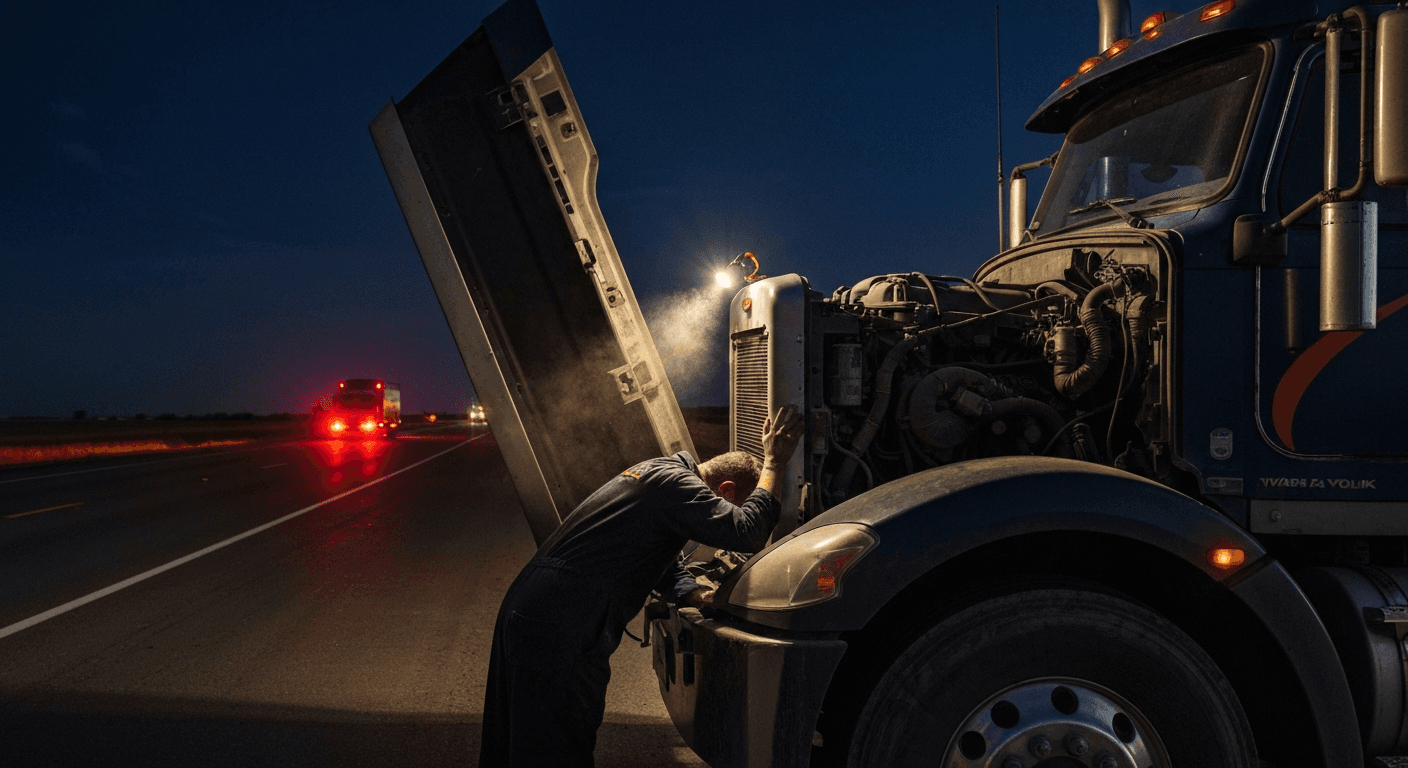
A Thermo King APU that won't start is usually one of six things, in this rough order of frequency: battery state of charge, glow plug or controller fault, fuel supply, starter or starter solenoid, controller software fault, or the safety lockout sequence triggered by a prior fault that's still active. Most no-start calls resolve in 30-90 minutes with a structured diagnostic approach. Here's the flow we follow on a TriPac or TriPac Evolution.
Step 1 — Battery state of charge
Probably 40% of no-start calls come down to battery condition. The APU draws from the tractor battery bank (or its dedicated APU battery on Evolution units with the optional setup). Low voltage at start attempt causes the controller to abort with a vague fault. Check voltage at the APU controller input before anything else — minimum spec is typically 11.8V cold-cranking. Below that and the diagnosis is the battery, not the APU.
- Voltage above 12.4V at rest → batteries probably OK, look further
- Voltage 11.8-12.3V at rest → marginal, may start in summer but not in winter
- Voltage below 11.8V at rest → batteries first, then re-test APU
Step 2 — Glow plug system
TriPac engines are small diesels (Kubota or similar) with glow plugs for cold starts. A failed glow plug or glow plug controller stops cold starts cold — literally. The unit will crank but not light off. Diagnosis: pull the glow plug controller fuse, measure resistance to ground on each glow plug at the engine. Spec is typically 0.6-1.2 ohms per plug. Infinity = failed plug. Same ohms across all plugs but no starting = controller or wiring.
Step 3 — Fuel supply
APUs pull fuel from the main tractor tank (in most installations). Common fuel-supply failures:
- Plugged fuel filter — APU has its own small inline filter that gets ignored
- Failed APU electric fuel pump — usually audible (click on key-on or silent)
- Air leak in the fuel pickup line from tractor tank — diesel will start hard then die
- Empty fuel tank (yes, this happens — driver thinks he has half a tank, APU's pickup is higher than the tractor's)
Step 4 — Starter and solenoid
If you hear a click but no crank, the starter or solenoid is most likely. Test starter draw with a clamp meter on the positive cable — healthy draw is typically 80-150 amps. Excessive draw (over 200 amps) = mechanical bind in the starter. No draw = solenoid or wiring.
Step 5 — Controller software fault
TriPac Evolution controllers occasionally lock up after a power event (tractor battery disconnect, jump start, etc.) and need a manual reset. The reset sequence is in the operator's manual but commonly involves disconnecting APU power for 30 seconds, then reconnecting with all switches off, then powering up with the APU disable switch off. After a successful reset, fault history clears and the controller will attempt start normally.
Step 6 — Active fault lockout
If the APU detected a critical fault on a prior run (high coolant temp, low oil pressure, alternator fault, high inverter temp), it locks out further starts until the fault is cleared. The dash will usually display the active fault code. Looking up the code in the TriPac service manual tells you what needs to be addressed before a restart is permitted.
Carrier ComfortPro — different unit, similar logic
Carrier ComfortPro APUs follow a similar failure pattern but use different fault codes and a different controller. Battery, glow plug, fuel, starter, and lockout faults all manifest similarly. The diagnostic flow above applies in concept; specific tests differ. We carry ComfortPro service literature on the truck.
What APU maintenance prevents most no-starts
- Change APU oil at the manufacturer-specified interval (typically 1,000-1,500 run hours) — APUs run a LOT of low-load idle hours that load up the oil
- Replace APU fuel filter annually even if it looks fine — small filter, big consequences when plugged
- Test APU batteries monthly — load test, not just voltage check
- Run the APU through its cooling and heating cycles weekly even when not needed, to keep refrigerant circulating and seals lubricated
- Inspect the drive belt every PM — they're cheap and break expensively
Frequently asked
Why won't my Thermo King APU start when it's cold?+
Usually glow plug system failure or marginal battery state of charge. Cold weather amplifies both — low battery voltage and weak glow plugs that worked fine in summer fail at 10°F.
Can a mobile mechanic fix a Thermo King APU on-site?+
Yes for the majority of failures — battery work, glow plugs, fuel filter, starter, alternator, controller reset, sensor replacements. Major engine rebuilds need a shop.
How much does APU service cost?+
Mobile diagnostic call typically $200-$350 on top of parts and labor for the actual repair. Common fixes (battery, glow plug, filter) total $300-$700 mobile. Alternator or starter replacement $600-$1,100.
Can the APU drain my tractor batteries while parked?+
Yes if the auto-shutoff is disabled or faulty. The APU is supposed to monitor battery voltage and shut down before depleting the bank. Most no-start-after-overnight-park issues are this loop misbehaving.
Do you carry common APU parts on the service truck?+
We stock TriPac and TriPac Evolution glow plugs, fuel filters, alternators, starters, and common sensors. ComfortPro common parts as well. Less common items we source from Lincoln or Omaha parts network same-day.
Related
Truck down? We dispatch 24/7.
100-mile radius from Lincoln, NE.