
What to do when your DEF light comes on
An amber DEF light isn't an emergency. A 5-MPH derate is. Here's what each stage of the DEF warning sequence means, how long you have, and what to do at each point.
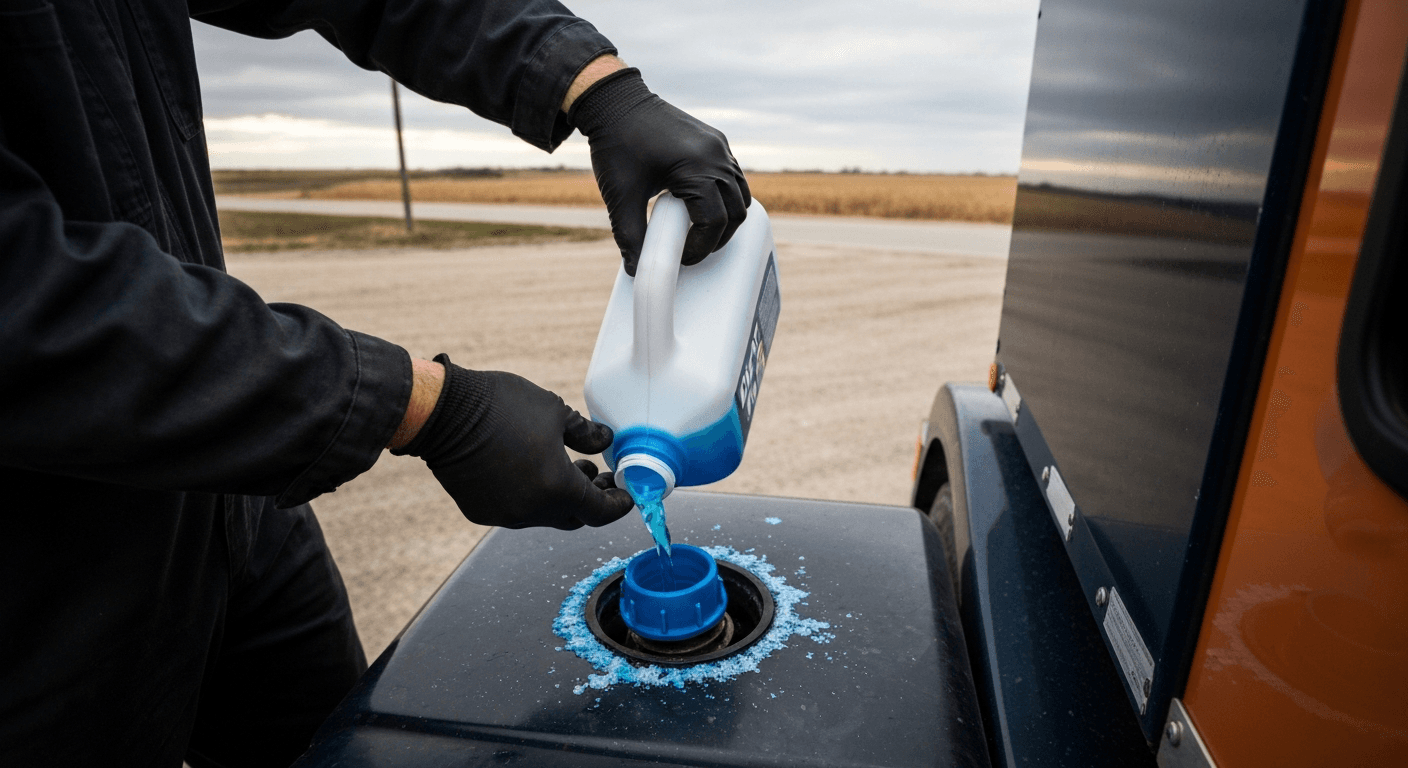
If your DEF light just came on, you have hours — sometimes a day — before it becomes a roadside problem. The DEF warning sequence is deliberately graduated: EPA emissions regulations require manufacturers to give drivers progressively louder warnings before the truck protects itself by going into 5-MPH limp mode. Understanding which stage you're in tells you whether to fix it at your next planned stop or call a mobile mechanic right now.
The four DEF warning stages
Every modern Class 8 truck — Cummins, Detroit, PACCAR, Volvo, Mack — follows the same EPA-mandated DEF warning escalation. The exact warning text varies by manufacturer, but the stages and triggers are standardized.
| Stage | What you see | Trigger | Time you have |
|---|---|---|---|
| 1 | Amber DEF light, possibly "DEF low" message | DEF tank at 10% or below | ~300 miles or one shift |
| 2 | Solid amber + audible chime | DEF tank at 5% or below, OR sensor fault | ~150 miles |
| 3 | Flashing amber, possible CEL, 25% power reduction | Empty DEF tank OR persistent sensor fault | Until you stop and restart, then derate begins |
| 4 | Solid red, 5-MPH limp mode | Truck restarted without correction | You're done until repair |
Stage 1 — Amber light only
This is the easy stage. Your DEF level is low (around 10%) but everything is working. You can drive normally for another 200-300 miles depending on consumption. Pull into any truck stop with DEF and fill up. A 2.5-gallon jug from the cashier costs $15-25; a bulk pump if available is half that.
Stage 2 — Amber light plus chime
Two possibilities: your DEF tank is now at 5% or less and you ignored Stage 1, OR a sensor or doser fault has triggered the warning early. If you just refilled DEF and the warning persists, you're looking at a fault — not a fluid level issue. At this stage you still have roughly 150 miles before derate, but every mile that passes without diagnosis tightens the window.
Stage 3 — Flashing light and 25% power reduction
The truck is now reducing engine power to enforce attention. You can still drive — just slower with less torque, which is noticeable on grades. Critically, once the engine is shut down at this stage, the next restart begins the 5-MPH limp mode countdown. Some manufacturers give you a one-time "limp home" allowance to get to a repair facility; others go straight to limp mode. Plan your stop carefully.
Stage 4 — 5-MPH limp mode
You're stopped. The truck will start, idle, and crawl forward at walking speed — enough to inch off the shoulder, not enough to move freight. Recovery requires diagnosing whatever caused the fault, repairing it, clearing the codes, and in some cases performing a manufacturer-specific reset procedure that requires a scan tool.
What causes a DEF light to come on at full DEF level
If you just filled DEF and the warning came back within a few miles, the cause is almost certainly one of these:
- DEF quality sensor reading the new fluid as out-of-spec (counterfeit DEF, contaminated jug, or sensor fault)
- Failed DEF doser injector — common after 400,000+ miles
- NOx sensor (upstream or downstream) reporting catalyst inefficiency
- DEF pump or supply module failure
- Frozen DEF lines in winter (below ~12°F) where heaters aren't working
Each of these requires a scan tool to confirm. Code SPN 3361 is the most common — it points to the DEF dosing valve. SPN 4364 points to the catalyst itself. SPN 4094 is a NOx sensor. We diagnose all of these on-site with manufacturer-level scan tools.
When to call a mobile mechanic vs limp to a shop
Rule of thumb: if you're in Stage 1 or 2 and within 50 miles of a planned stop with a shop, drive to it. If you're in Stage 3 with no repair facility within your derate window, call a mobile mechanic — they can reach you faster than you can crawl to them, and the cost of a service call is usually less than the freight penalty of missing a delivery window.
Frequently asked
Can I drive with a DEF light on?+
Yes, in Stages 1 and 2 (amber). Stage 3 (flashing) still allows driving but with 25% power loss — limp to a safe stop. Stage 4 (red, 5-MPH) is not drivable for freight.
How long can I drive on an empty DEF tank?+
Once truly empty, you typically get one shutdown cycle. Restart triggers the 5-MPH limp mode. The actual mileage between empty and derate depends on manufacturer programming but is usually under 50 miles.
Will adding DEF clear the light?+
If the cause was a low DEF level, yes — usually within 5-10 miles after restart. If the cause was a sensor or doser fault, no. The fault code has to be diagnosed and the underlying part repaired or replaced.
Can a mobile mechanic clear a DEF derate on the side of the road?+
Yes. With a manufacturer-level scan tool for your engine family we read the active codes, perform the repair on-site, clear the codes, and run any required regen or reset procedure. Most calls resolve in 60-90 minutes.
Is there a way to bypass or delete the DEF system?+
Yes technically, but it's a federal crime under the Clean Air Act with fines up to $4,819 per day per truck, and it voids your engine warranty. We do not perform DEF deletes. See our separate post on this topic.
How much does DEF cost at a truck stop?+
Bulk DEF at the pump runs about $3.50-$4.50 per gallon in eastern Nebraska as of 2026. Jugged DEF (2.5 gallon) is $15-25 each. Bulk is always cheaper if available.
Related
More in DEF / Emissions
DEF Full but Still in a 5 MPH Derate? SCR Conversion Fault on a DD15 at I-80 Exit 401
6 min · July 8, 2026
DEF Light Stayed On After a Refill? Why a Bad Jug Dropped This Kenworth to 5 MPH on I-80
6 min · July 8, 2026
Catching a Volvo D13 Outlet NOx Sensor Failure Before It Derated (SPN 3216)
6 min · July 8, 2026
Truck down? We dispatch 24/7.
100-mile radius from Lincoln, NE.